Search This Blog

Showing posts with label solar flare latest. Show all posts

Friday, 27 April 2012

Latest Solar Flare Activity Update April 27 2012

Latest Solar Flare Activity: Latest Solar Flare Activity Update April 27 2012

Solar Update
Solar activity increased to moderate levels with an M1.0 solar flare detected Friday morning around Sunspot 1466 in the northern hemisphere. Sunspot 1465 in the south produced a minor C2.4 flare at 11:02 UTC. Sunspot 1469 located in the southeast quadrant, appears to be growing on Friday. Finally, A new region looks to be hiding on the southeast limb and will soon begin to rotate into view. There will continue to be a small chance for an isolated M-Class flare.


Sunspot Update: The region hiding on the southeast limb is now rotating into view and a Sunspot is  
Joint USAF/NOAA Report of Solar and Geophysical Activity SDF Number 118 Issued at 2200Z on 27 Apr 2012 IA. Analysis of Solar Active Regions and Activity from 26/2100Z to 27/2100Z: Solar activity was at moderate levels due to an M1/1n flare at 27/0824Z from Region 1466 (N11W38). Other activity consisted of single, low-level C-class flares from Regions 1459 (S19W88), 1465 (S17W53), 1467 (N11E32), 1469 (S24E28) and 1466. During the period, Region 1465 developed into a beta-gamma-delta magnetic configuration while the remaining regions showed little change. Numerous non-Earth directed CMEs were observed off the SW limb over the past 24 hours, all originating from old Region 1462 (S25, L=139) which rotated around the west on 24 April. IB. Solar Activity Forecast: Solar activity is expected to be low with a slight chance for M-class activity for the next three days (28 - 30 April). IIA. Geophysical Activity Summary 26/2100Z to 27/2100Z: The geomagnetic field was at quiet to unsettled levels. Through the period, ACE solar wind velocities steadily decreased from about 560 km/s to near 500km/s while the Bz component of the interplanetary magnetic field was variable between +/-4 nT. The greater than 2 MeV electron flux at geosynchronous orbit was at high levels throughout the period. IIB. Geophysical Activity Forecast: The geomagnetic field is expected to be at predominately quiet levels for the next three days (28 - 30 April).

Monday, 16 April 2012

Latest Solar Flare Activity: Latest solar flare report April 16 2012

Latest Solar Flare Activity: Latest solar flare report April 16 2012: Latest Solar Flare Report April 16 2012 The returning region off the northeast limb looks to be providing us with some Solar Fireworks. Sunspot 1455 which is turning closer to the western limb with every passing hour, did form some new spots on Sunday. This region may produce C-Class flares. Sunspot cluster 1459 in the southeast quadrant covers a large area but has yet to produce a noteworthy flare. There will remain a small risk for an M-Class event.

Joint USAF/NOAA Report of Solar and Geophysical Activity
SDF Number 107 Issued at 2200Z on 16 Apr 2012

IA. Analysis of Solar Active Regions and Activity from 15/2100Z
to 16/2100Z: Solar activity was moderate during the past 24 hours.
An M1 flare was observed from a region around the east limb at
16/1745Z. Region 1459 (S15E56) continued to grow and is now
considered an Fhi-beta type group. A filament erupted at
approximately 16/1300Z near S43E33. The associated CME is not
expected to be geoeffective.

IB. Solar Activity Forecast: Solar activity is expected to be low
with a slight chance for M-class flares for the next three days
(17-19 April).

IIA. Geophysical Activity Summary 15/2100Z to 16/2100Z:
The geomagnetic field was quiet during the past 24 hours. The greater
than 2 MeV electron flux at geosynchronous orbit was at high levels
throughout the period.

IIB. Geophysical Activity Forecast: The geomagnetic field is
expected to be quiet for the next three days (17-19 April).

Monday, 19 March 2012

latest Report of Solar flare and Geophysical Activity

http://solarwindstorm.blogspot.ca

Latest Solar Flare Activity: latest Report of Solar flare and Geophysical Activity

Analysis of Solar Active Regions and Activity from  17/2100Z
to 18/2100Z:  Solar activity was low.  Region 1434 (S20W40) produced
a single C1/Sn flare at 17/0237Z and ended the period as a Dso type
group with beta magnetic characteristics.  Region 1435 (S25W50) grew
larger and more magnetically complex, ending as a Dao type group
with beta-gamma magnetic characteristics.  A non-Earth-directed CME
was observed in SOHO/LASCO C2 imagery at 18/0024Z and believed to
originate from old Region 1429 (N19, L=295).
http://solarwindstorm.blogspot.ca

Friday, 9 March 2012

Geomagnetic Storm and Solar Wind Activity Report

Updated Mar 09 2200 UTC

Joint USAF/NOAA Report of Solar and Geophysical Activity

SDF Number 069 Issued at 2200Z on 09 Mar 2012


IA.  Analysis of Solar Active Regions and Activity from  08/2100Z

to 09/2100Z:  Solar activity reached high levels today.  Region 1429

(N18W13) produced an M6 flare at 09/0353Z.  Associated with this

event was Type II (1285 km/s) and Type IV radio sweeps along with a

full halo CME first seen in SOHO/LASCO C2 imagery at 09/0426Z.  The

CME had an estimated plane-of-sky speed of 850 km/s in STEREO B COR2

imagery.  Separation and slight decay within the intermediate area

was observed in Region 1429, however it still remained a large Ekc

spot group with a Beta-Gamma-Delta magnetic configuration.  A new

spot group rotated onto the NE limb and was numbered Region 1432

(N18E69).  This new region is too close to the limb to accurately

determine the spot and magnetic classification, however it produced

a C9 flare at 09/2025Z.


IB.  Solar Activity Forecast:  Solar activity is expected to continue

at low to moderate levels with a chance for X-class activity from

Region 1429 for the next three days (10 - 12 March).


IIA.  Geophysical Activity Summary 08/2100Z to 09/2100Z:

The geomagnetic field was at active to severe storm conditions due to

continued activity from the sheath region associated with the 07

March CME.  At approximately 09/0049Z, the Bz component of the

interplanetary magnetic field started to rotate towards a more

magnetically connected polarity.  Bz continued to be negative for

several hours reaching values near -17 nT with an approximate solar

wind speed over 600 km/s.  The geomagnetic field responded with

major to severe storm periods during the periods 09/0300 - 1500Z. 

Solar wind remained elevated around 600 km/s by the end of the

period.  The greater than 10 MeV proton event that began at 07/0510Z

is ongoing.  The greater than 100 MeV proton event that began at

07/0405 is ongoing.


IIB.  Geophysical Activity Forecast:  The geomagnetic field is

expected to be under the influence of the current CME through early

on day 1.  Unsettled to active conditions, with isolated minor storm

periods, are possible is expected as the CME continues to wane. 

Approximately early to mid-day on day 2 (11 March), the CME

associated with todays M-6 flare is expected to become

geoeffective.  Active to severe storm periods are expected (Kp 4 -

7) with this event.  Unsettled to active conditions with minor storm

periods possible is expected on day 3 (12 March) as conditions are

expected to slowly dissipate.


Wednesday, 7 March 2012

Latest Solar Flare Activity: latest news of Solar Flare Activity March 7 2012

Latest Solar Flare Activity: latest news of Solar Flare Activity March 7 2012:
Analysis of Solar Active Regions and Activity from  06/2100Z
to 07/2100Z:  Solar activity was high. Region 1429 (N17E15) produced
an X5/3B long-duration flare with maximum at 07/0024Z. The event was
associated with type II and type IV radio sweeps and a full halo,
though slightly asymmetric coronal mass ejection (CME). The CME had
an estimated plane of sky speed of about 2200 km/s. During the decay
of the X5 x-ray event, Region 1430 (N21W00) produced an X1/Sf at
0114Z. Region 1429 dominates the disk with an area of about 1300
millionths. Observations show slight separation of the central spots
but the region continues to be large and magnetically complex;
multiple deltas are clearly evident as well as a dominant east-west
polarity inversion line. Region 1430 showed steady growth during the
past 24 hours. Region 1428 (S17W05) also showed growth during the
period but was relatively quiet and stable.

IB.  Solar Activity Forecast:  Solar activity is expected to be
moderate to high. M-class level activity is expected to continue and
there continues to be a good chance for an additional major flare
and/or proton producing event from Region 1429. In addition, the
growth trend in 1430 suggests that it may also contribute to the
M-flare activity during the next three days.

IIA.  Geophysical Activity Summary 06/2100Z to 07/2100Z:
The geomagnetic field ranged from quiet to major storm levels during
the past 24 hours. Activity levels were initially quiet to unsettled
until an interplanetary shock arrived. The shock was seen at ACE at
07/0334Z and was followed by a sudden storm commencement (SSC) at
Earth at 07/0421Z. Although solar wind speeds did not increase
greatly, the interplanetary magnetic field (IMF) and density did
increase markedly and the Bz component had numerous intervals of
fairly strong southward orientation (with the strongest negative
intervals at about -15 to -20 nT). Geomagnetic activity increased to
minor to major storm levels following the SSC with some periods of
severe storm levels at high latitudes. The disturbance most likely
originated from the X1/halo CME that occurred on 05 March. A greater
than 10 MeV proton event began at 07/0500Z and has reached a peak so
far of 1630 PFU at 1540Z. A greater than 100 MeV proton event also
occurred, beginning at 07/0405Z and reaching an apparent maximum of
69 PFU at 07/1525Z. Both of these events continue in progress and
are clearly associated with todays X5/Full halo CME event.

IIB.  Geophysical Activity Forecast:  The geomagnetic field is
expected to be active initially on day 1 (08 March) but is expected
to increase to major storm levels with a likelihood for isolated
severe storm levels after the arrival of the CME from todays
X5/full halo event. The arrival time is estimated to be sometime
between 0600-1000Z. Minor to major storm levels are expected to
continue partway (6-12 hours) into the second day (09 March), but a
decline to predominantly active levels is expected for the remainder
of the day. Predominantly unsettled levels are expected for the
third day (10 March). The greater than 10 MeV proton event is
expected to continue through the first day and is also likely to
continue partway through the second day. The greater than 100 Mev
proton event is expected to slowly decline over the next 24 hours.

Tuesday, 6 March 2012

Latest Solar Flare Activity: Latest Solar Flare Activity: March 2012

Latest Solar Flare Activity: Latest Solar Flare Activity: March 2012:
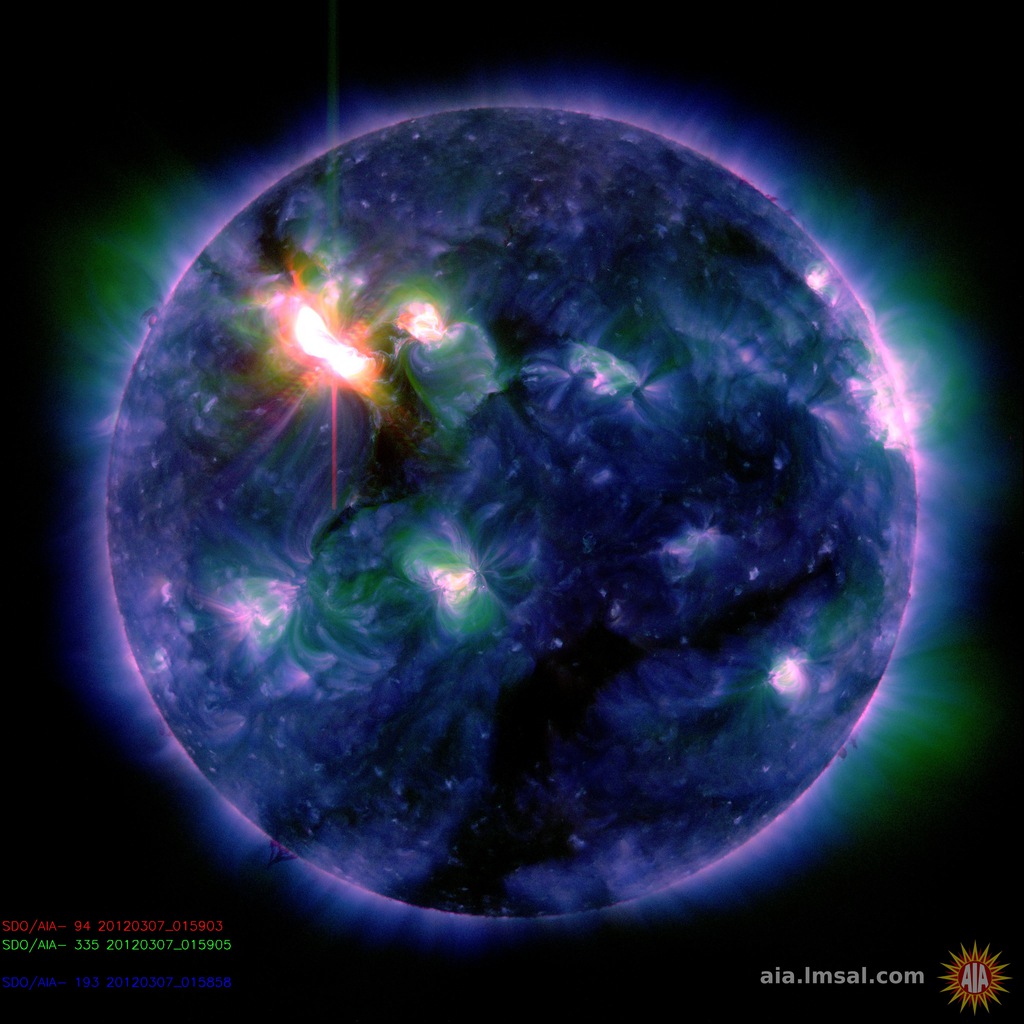
Big sunspot AR1429 has unleashed another major flare. This one is the strongest yet, an X5-class eruption on March 7th at 00:28 UT. NASA's Solar Dynamics Observatory recorded the extreme UV flash:
This eruption hurled a bright CME into space. First-look data from STEREO-B are not sufficient to determine if the cloud is heading for Earth. Our best guess is "probably, yes, but not directly toward Earth." A glancing blow to our planet's magnetosphere is possible on March 8th or 9th. Stay tuned for updates